
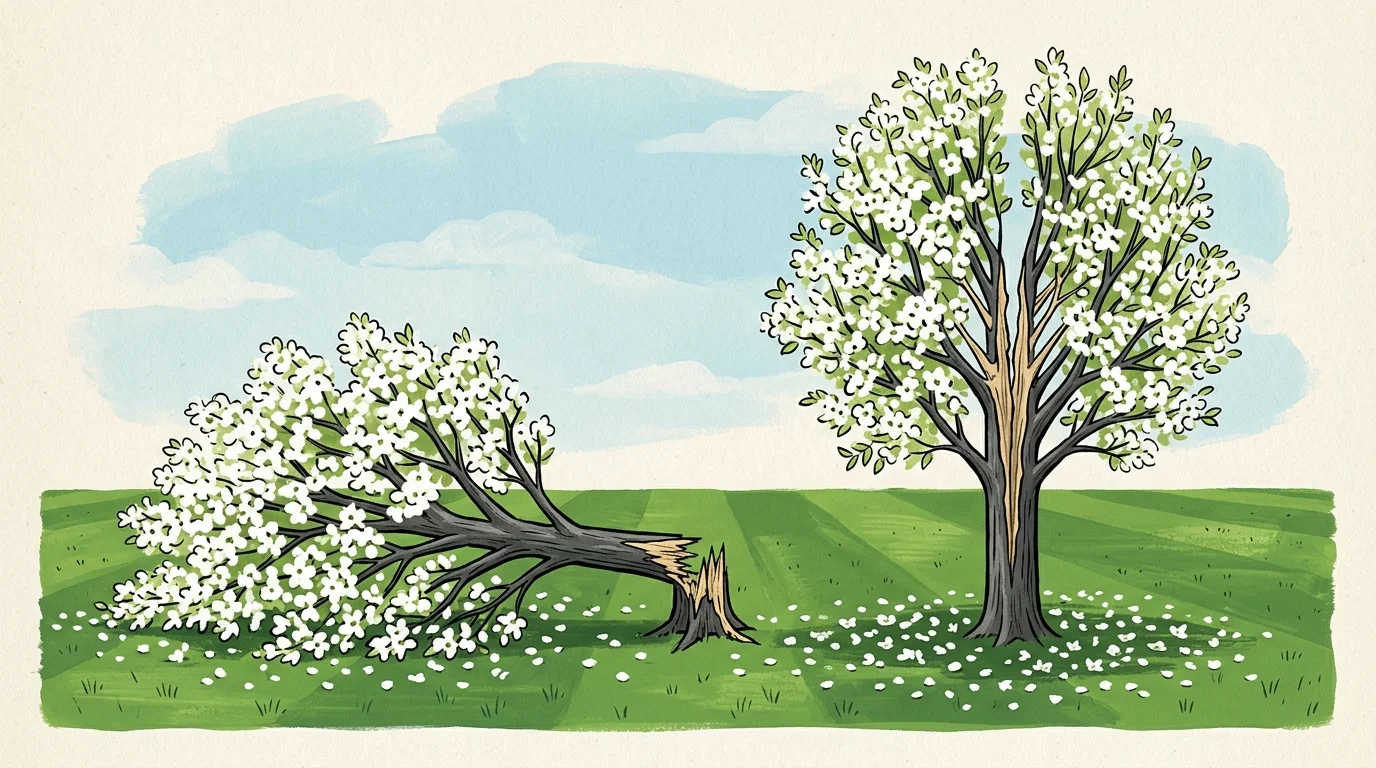
Tip #1: Bradford Pear (Pyrus calleryana)
The Bradford Pear routinely tops the list of the absolute worst trees for residential landscapes—and for several critical reasons. Initially praised for its rapid growth and perfectly symmetrical canopy, this popular spring bloomer hides a fragile, destructive nature. The tree naturally forms extremely narrow branch angles; as the canopy matures and adds heavy foliage, these weak structural junctions become ticking time bombs. A standard spring thunderstorm or a moderate winter ice accumulation easily rips the tree perfectly in half, leaving you with a massive debris pile and an emergency removal bill that often exceeds a thousand dollars.
Furthermore, the pristine white blossoms carry a notoriously putrid scent, frequently compared to rotting fish or garbage, which completely ruins your outdoor spring experience. Beyond the structural and sensory offenses, the Bradford Pear ranks among the most aggressive invasive trees in North America. They rapidly escape residential cultivation to choke out native forests and fields, creating dense, thorny thickets that destroy local ecosystems. Instead of making common tree planting mistakes with this brittle nightmare, elevate your landscape by choosing superior native alternatives like the Eastern Redbud or the elegant Serviceberry, which provide gorgeous spring color without the massive structural liability.
2 Responses
I could not see the list of 10 trees you shouldn’t plant in your yard. Where was it?
Under the text, there are the buttons for the pages 1 2 3… up to 13, with the first button in green.