
The Science Behind Rainwater and Rapid Growth
You have likely noticed how much greener and more vibrant your backyard plants look the morning after a heavy summer thunderstorm. This dramatic transformation is not just your imagination; it is the result of fascinating atmospheric chemistry. Rainwater provides fundamental benefits that the water from your garden hose simply lacks, making it the ultimate elixir for your plants.
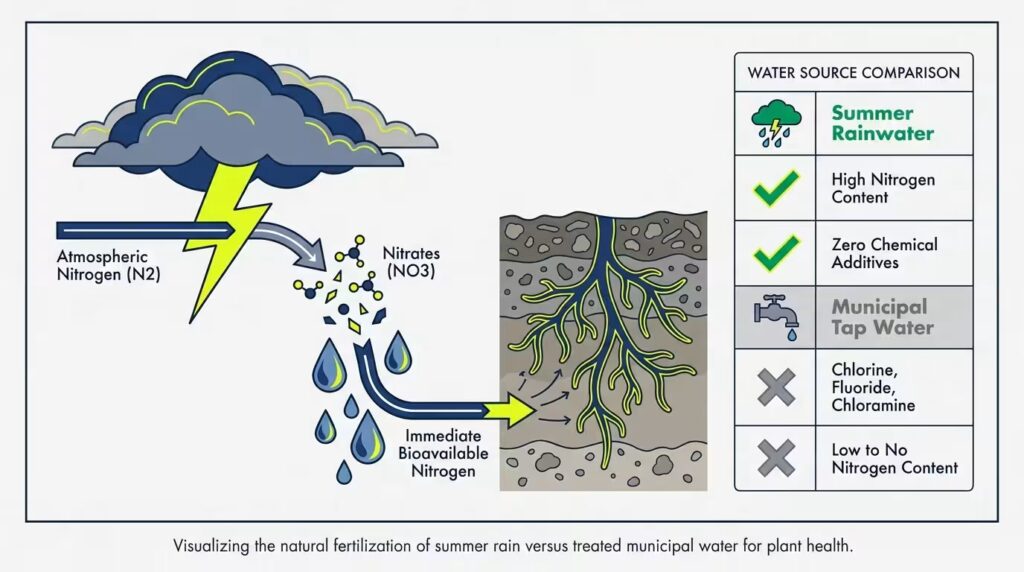
During a summer storm, lightning superheats the surrounding air. This intense burst of energy breaks the strong bonds of atmospheric nitrogen gas, allowing it to combine with oxygen to form nitrates.
These nitrates dissolve into the falling rain, creating a highly dilute, highly bioavailable liquid fertilizer. When this nitrate-rich water hits the soil in your containers or raised beds, plant roots absorb it immediately, fueling rapid cellular expansion and producing deep green, vigorous new growth.
Furthermore, rainwater is naturally soft and slightly acidic. Most vegetables, herbs, and ornamental plants prefer a slightly acidic soil pH, which allows them to uptake nutrients more efficiently. Municipal tap water, on the other hand, is often treated with chlorine, chloramine, and fluoride to keep it safe for human consumption.
While safe for us, these chemicals can gradually accumulate in small garden pots, eventually disrupting the delicate balance of beneficial microbes and fungi living in your potting soil.
Rainwater also physically cleans the environment. As raindrops fall, they capture airborne dust, pollen, and pollutants, washing them away from the leaves of your plants. This thorough cleansing opens up the stomata—the microscopic pores on the surface of leaves—allowing the plant to “breathe” better and photosynthesize more effectively. A clean leaf is an efficient leaf, and an efficient leaf means a fast growing plant.
| Characteristic | Summer Rainwater | Municipal Tap Water | Impact on Your Garden |
|---|---|---|---|
| Nitrogen Content | High (especially after lightning) | Zero | Rainwater provides an immediate burst of natural fertilizer for lush, green growth. |
| Chemical Additives | None | Chlorine, Fluoride, Chloramine | Rainwater protects beneficial soil microbes; tap water can suppress them over time. |
| pH Level | Slightly Acidic (approx. 5.5 to 6.0) | Neutral to Alkaline (approx. 7.0 to 8.5) | Slightly acidic rainwater unlocks trapped nutrients in the soil, making them available to roots. |
| Dissolved Oxygen | Very High | Low to Moderate | Highly oxygenated rainwater prevents root rot and suffocated roots in container gardens. |