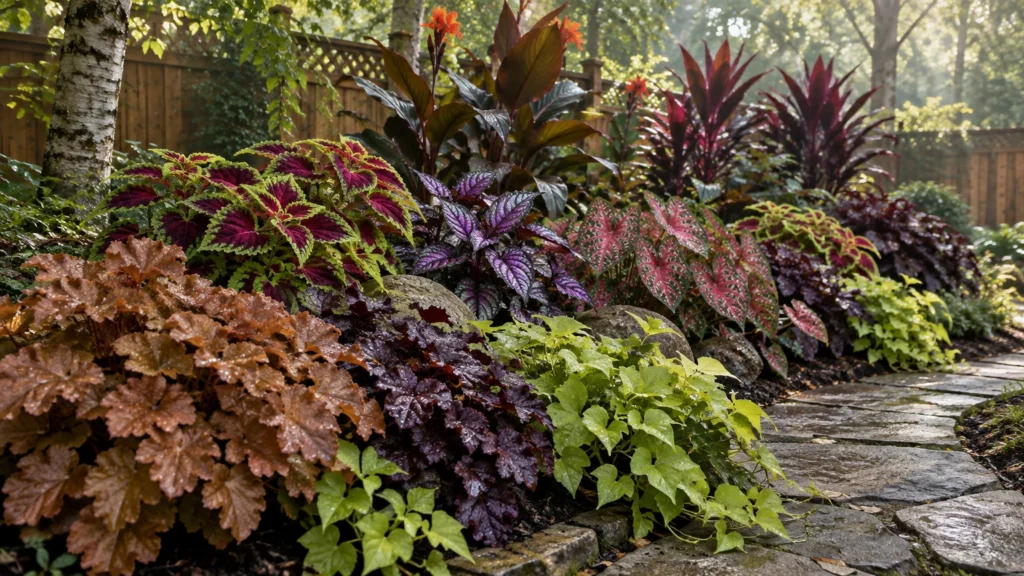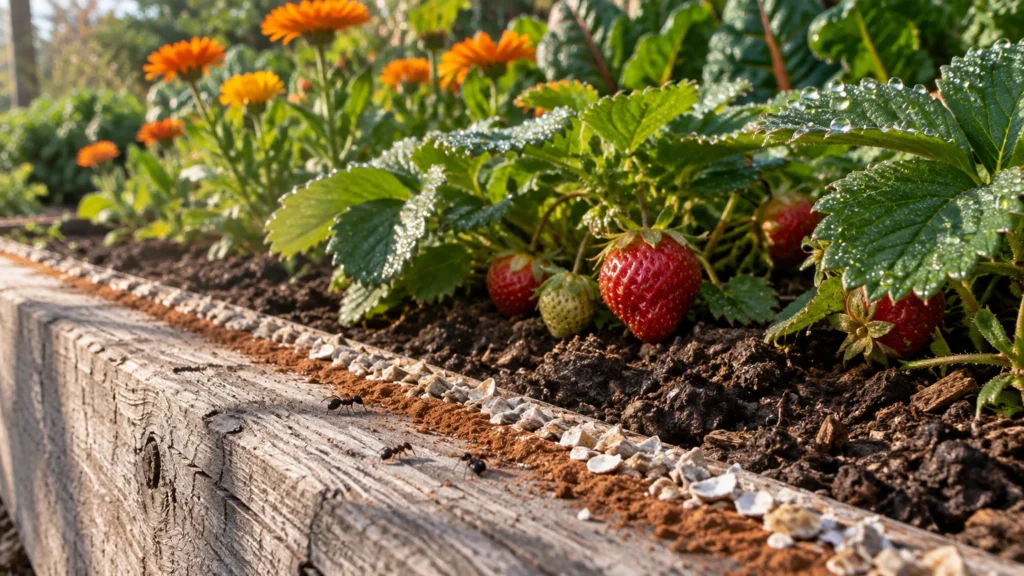
Dark foliage instantly elevates a landscape by creating high-contrast anchors that make bright blooms pop. You can transform an ordinary yard into an architectural showcase simply by introducing moody, dark leaf plants into your beds.
True black tones rarely appear in nature, yet these saturated purple, charcoal, and deep bronze varieties absorb ambient light to add unmatched depth. They create a dramatic garden tapestry that stays visually striking from spring through late autumn.
Whether you are crafting an evocative gothic garden or balancing lime-green groundcovers, these selections offer unbeatable presence. Here is how you can use dramatic garden plants to build a sophisticated, high-impact yard.
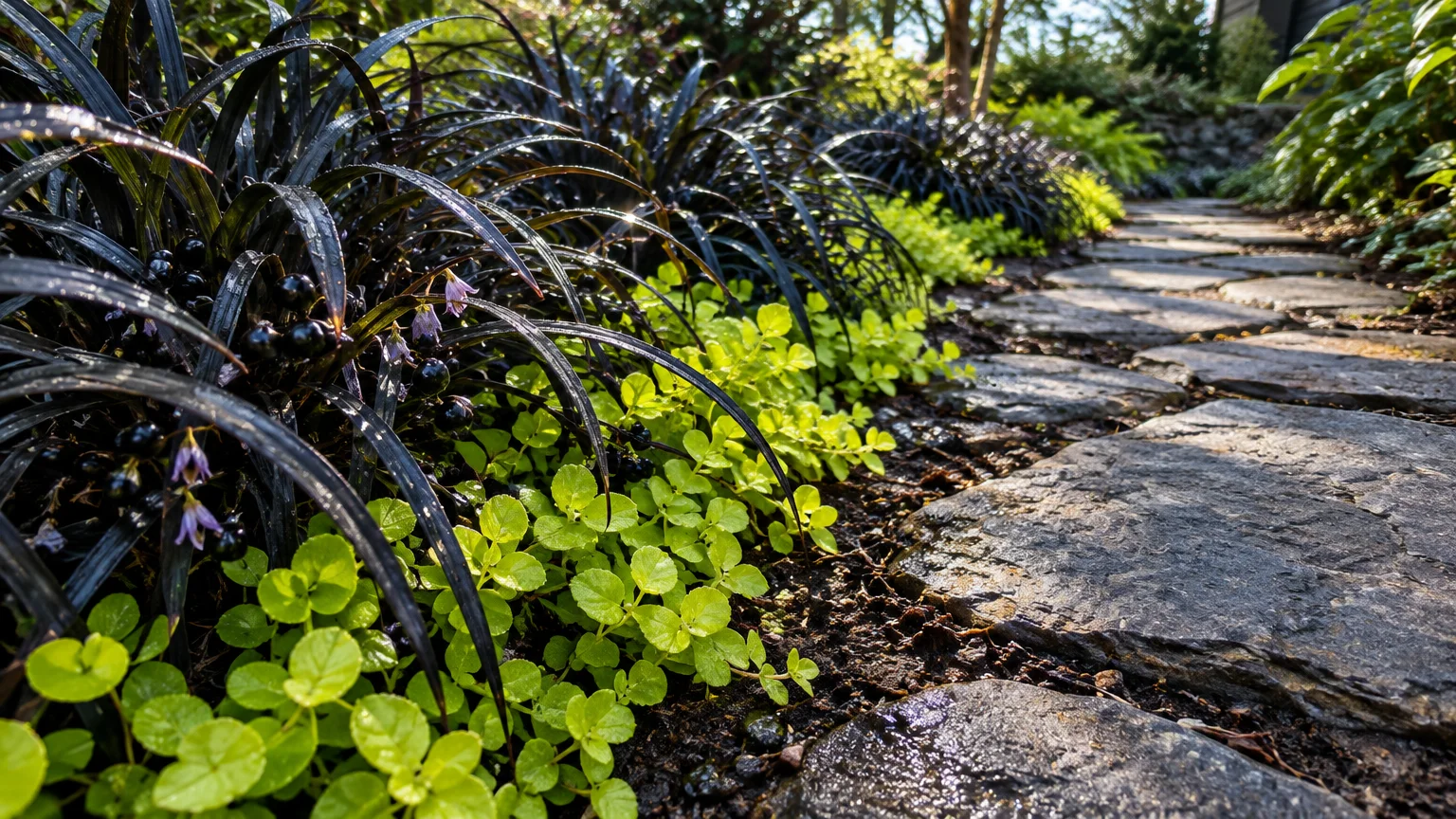
Outdoor Strategy #1: Black Mondo Grass (Ophiopogon planiscapus ‘Nigrescens’)
Black mondo grass provides a ribbon of near-black, strappy foliage that remains evergreen in mild climates. This slow-spreading perennial thrives in USDA Zones 5 through 10, reaching eight inches in height.
Plant it in well-draining, slightly acidic soil where it receives partial shade or full sun. While it tolerates shaded borders, direct morning sunlight intensifies its dark, purplish-black pigmentation.
Use this black leaved perennial along stone pathways or as an edging plant in front of bright perennials. The slender black blades form dense tufts that suppress weeds while crisply defining bed edges.
Pair black mondo grass with chartreuse companions like golden creeping Jenny or scotch moss. The vivid contrast highlights the unique coloration and prevents dark blades from visually disappearing against rich soil.
In midsummer, small pale lilac bell flowers appear, followed by shiny black berries that persist into winter. Keep the soil consistently moist during its first growing season to establish strong rhizomes.
Outdoor Strategy #2: Black Lace Elderberry (Sambucus nigra ‘Black Lace’)
Black Lace elderberry delivers an architectural silhouette with deeply dissected foliage that mimics Japanese maples. It thrives across USDA Zones 4 through 7, growing eight feet tall and wide.
The intense purplish-black leaves retain their dark saturation best when you position the shrub in full sun. In heavy shade, the foliage shifts toward a muted bronzed green.
During early summer, large umbels of soft pink blooms emerge, carrying a delicate lemon fragrance. These flower heads contrast against the dark canopy before yielding edible elderberries that attract songbirds.
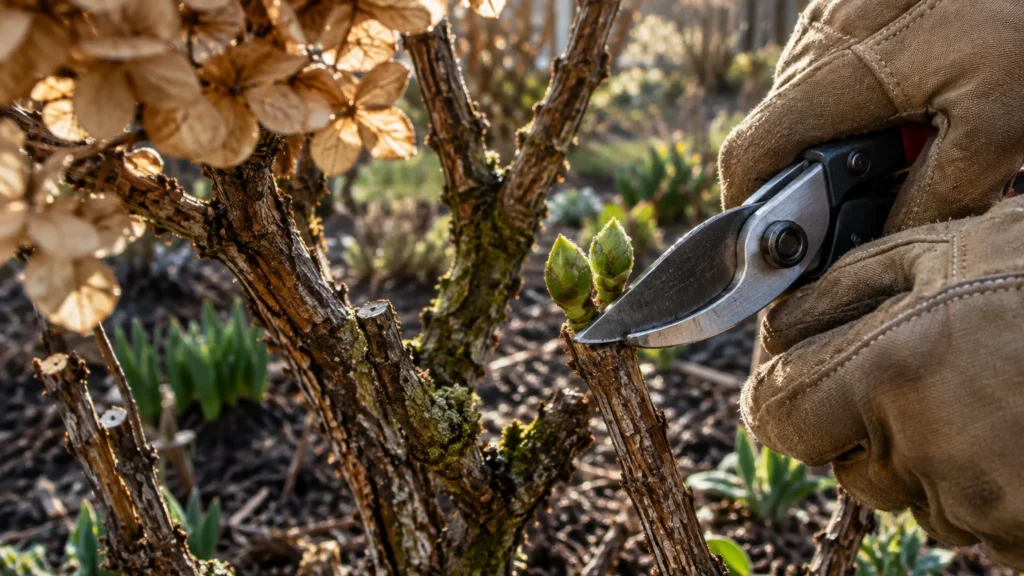
Prune your elderberry hard in late winter to encourage vigorous new stems with the darkest color. You can train it as a multi-stemmed focal specimen or integrate it into a boundary hedge.
Elderberries demand moist, well-draining soil enriched with composted organic matter. Apply a three-inch layer of organic mulch around the root zone to conserve moisture and regulate soil temperature.
Outdoor Strategy #3: Black Magic Elephant Ear (Colocasia esculenta ‘Black Magic’)
Black Magic elephant ear produces enormous heart-shaped leaves that can reach two feet in length. This dramatic tropical foliage plant creates an instant statement in patio containers and border plantings.
It thrives as a perennial in USDA Zones 8 through 11 and serves as an annual in colder regions. The foliage emerges with dusty green undertones and rapidly matures into a rich, velvety purple-black hue.
Position this specimen in full sun to maximize anthocyanin development; full sunlight turns the massive leaves inky black. In hot southern climates, provide light afternoon shade to avoid foliage scorch during intense heatwaves.
This heavy feeder requires organically rich soil and substantial moisture to support its rapid leaf production. It tolerates standing water, making it a stellar candidate for the margins of garden ponds.
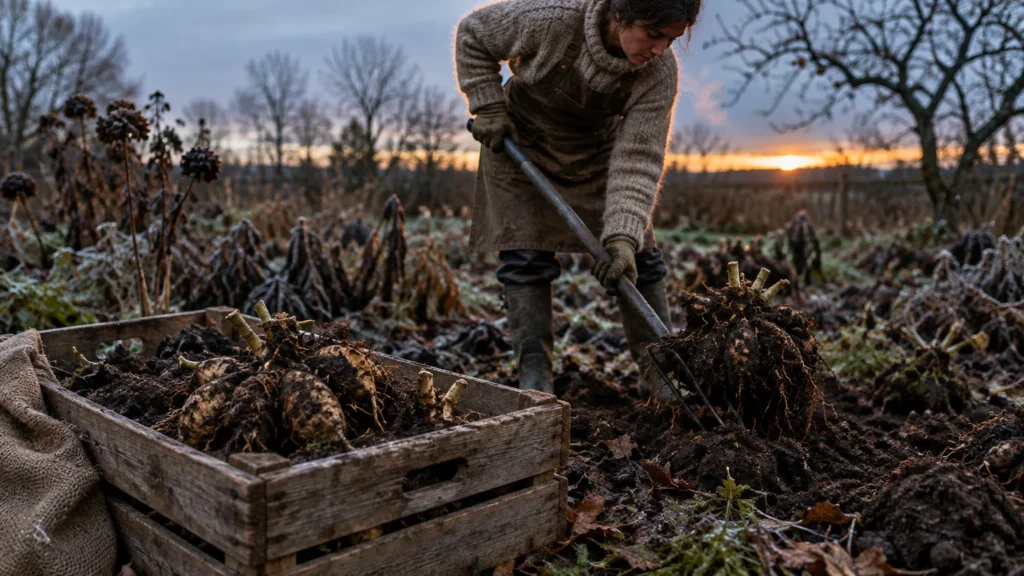
In cold zones, dig the tubers before your first fall freeze and store them in dry peat moss. Replant them outdoors in spring once soil temperatures consistently exceed sixty degrees Fahrenheit.
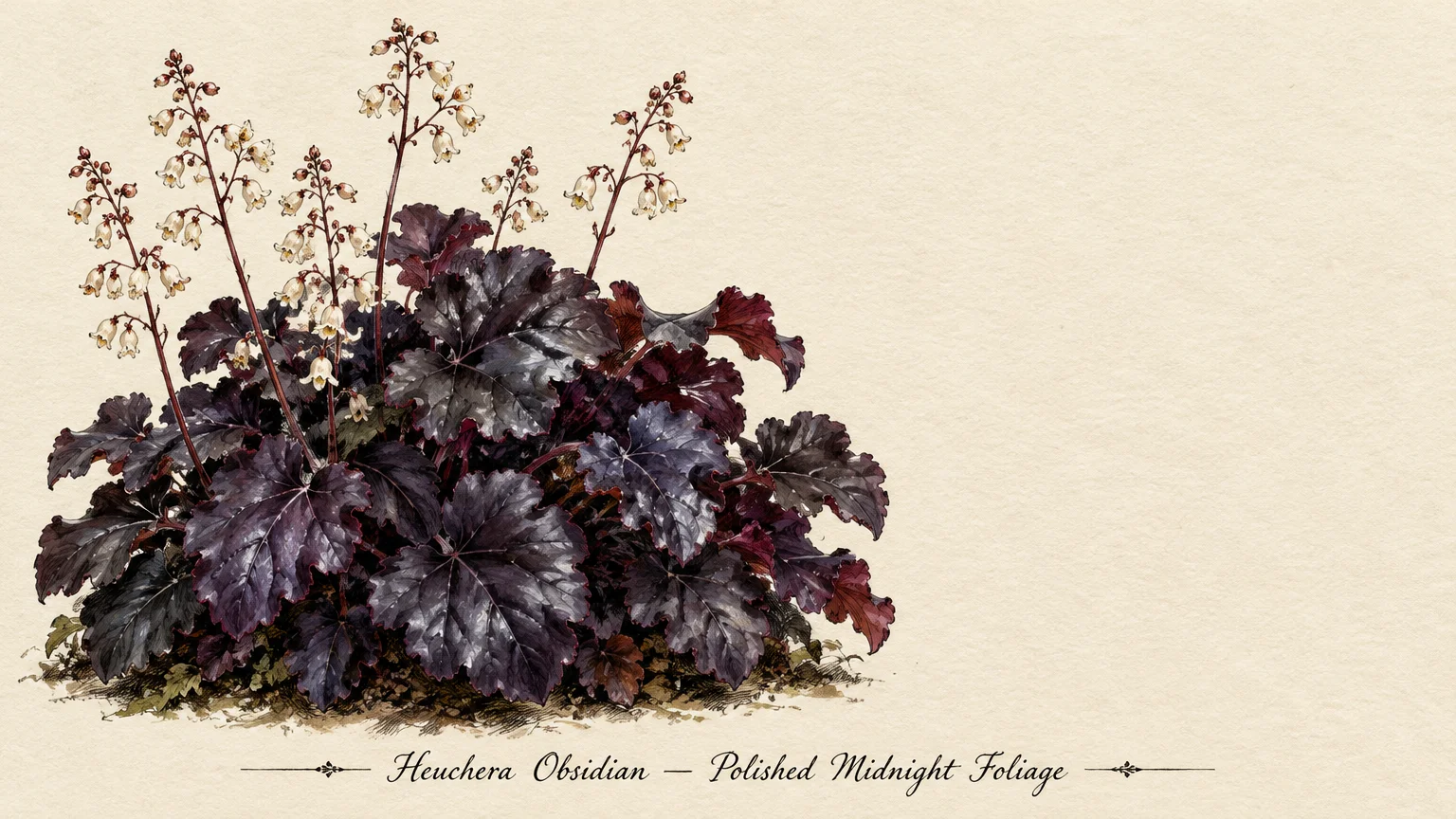
Outdoor Strategy #4: Obsidian Coral Bells (Heuchera ‘Obsidian’)
Obsidian coral bells stands out as the gold standard among dark leaf plants for compact garden borders. Its broad, lobed leaves display a polished sheen and maintain their midnight-purple shade all season long.
Hardy in USDA Zones 4 through 9, this mounding perennial grows ten inches tall and sixteen inches wide. Unlike older purple cultivars, the foliage resists fading even during hot summer months.
Plant it in fertile, well-draining soil with a neutral to slightly acidic pH. Obsidian tolerates full sun in northern zones but performs best with dappled afternoon shade in warmer regions.
Slender two-foot flower scapes emerge in late spring, bearing delicate ivory blossoms that attract native bees and hummingbirds. These bright flowers appear to float above the dark mound like miniature stars.
Ensure excellent drainage around the root crown to prevent winter moisture damage. Divide crowded clumps every three to four years in early spring to maintain plant vigor and foliage density.
Outdoor Strategy #5: Diabolo Ninebark (Physocarpus opulifolius ‘Diabolo’)
Diabolo ninebark brings rugged resilience and four-season visual interest to challenging yard sites. This North American native cultivar thrives across USDA Zones 3 through 7, easily withstanding harsh winter temperatures.
It grows eight to ten feet tall with an arching habit, making it an exceptional privacy hedge. The maple-like leaves exhibit an intense wine-red to purple-black color in full sunlight.
Button-like clusters of creamy white flowers burst forth in late spring, creating striking contrast against the dark background. Red seed capsules follow the blooms, persisting into autumn alongside peeling, layered bark.
Plant Diabolo ninebark in full sun to achieve the deepest leaf pigmentation. It tolerates poor clay soils, drought conditions, and urban pollution once its extensive root system establishes.
Prune older stems down to the ground every few years after flowering to stimulate fresh, vibrant growth. This renewal pruning keeps the shrub dense while showcasing its characteristic exfoliating bark.
Outdoor Strategy #6: Bishop of Auckland Dahlia (Dahlia ‘Bishop of Auckland’)
Bishop of Auckland dahlia combines near-black dissected foliage with single, glowing velvet-crimson blossoms. It serves as a showstopping anchor in mixed perennial beds and formal decorative urns.
Perennial in USDA Zones 8 through 11, it grows vigorously as a warm-season annual in cooler climates. Plants reach three to four feet in height and two feet in spread by midsummer.
Situate this dahlia in full sun and fertile, humus-rich soil that drains freely. The open-centered flowers welcome bumblebees and butterflies, unlike dense double dahlias that hide nectar glands.
Deadhead spent flowers regularly to channel energy into fresh buds and prolong flowering until the first killing frost. Stake taller stems early in the season to shield heavy blooms from summer windstorms.
Lift the tuberous roots after light frost blackens the top growth if you garden in Zone 7 or below. Store the dormant tubers in a cool, dark garage packed in vermiculite over winter.
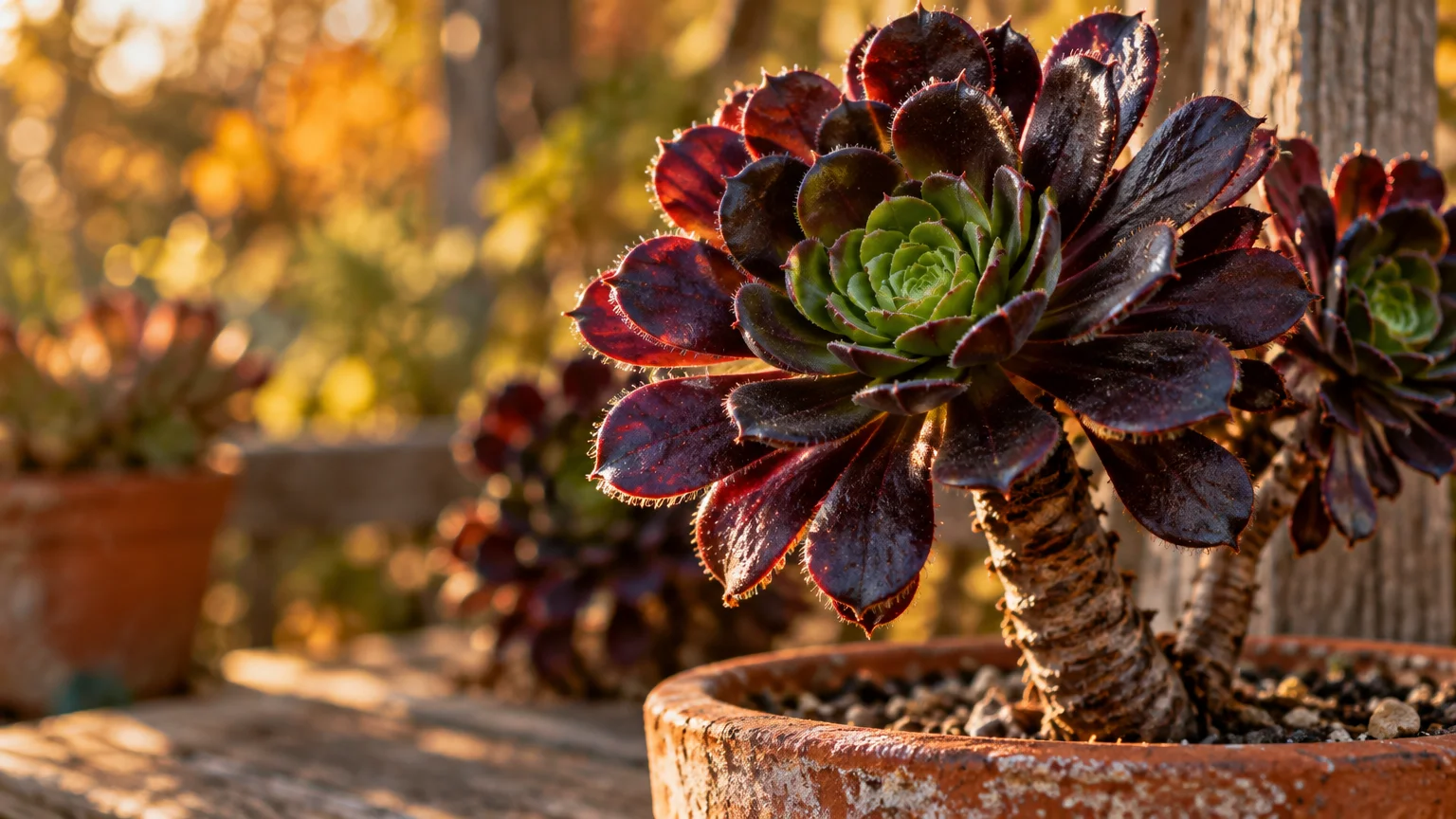
Outdoor Strategy #7: Black Rose Succulent (Aeonium arboreum ‘Zwartkop’)
Black Rose succulent produces sculptural rosettes of glossy, spatula-shaped leaves that turn almost jet-black under intense sunlight. This dramatic succulent thrives outdoors year-round in frost-free USDA Zones 9 through 11.
It grows on thick woody stems, forming branched subshrubs that reach two to three feet in height. Each rosette can expand up to eight inches wide, resembling an open, dark peony.
Plant it in coarse, sandy soil with impeccable drainage to prevent root rot during rainy periods. If you garden in colder zones, feature it in a decorative container that you can overwinter indoors.
Provide full sun for the darkest leaf saturation, though light shade during scorching midsummer afternoons prevents leaf burn. Bright yellow conical flower panicles emerge in winter, contrasting against the moody rosettes.
Water sparingly during summer dormancy, allowing the potting substrate to dry out almost completely between waterings. Resume regular moisture during autumn and spring when the plant enters active growth.
Outdoor Strategy #8: Royal Purple Smokebush (Cotinus coggygria ‘Royal Purple’)
Royal Purple smokebush commands attention in any landscape thanks to its rich maroon-purple, rounded leaves that resist fading. It performs reliably in USDA Zones 4 through 8, reaching twelve to fifteen feet tall.
Large, airy panicles of pinkish-buff filaments cover the shrub in early summer, creating a cloud of mist-like smoke. In autumn, the dark foliage ignites into brilliant shades of scarlet and orange.
Situate your smokebush in full sun and lean, well-draining soil for optimal color development and sturdy growth. Excessively fertile soils produce weak, floppy stems and diminish the foliage vibrancy.
You can train this versatile woody plant as an upright small tree or cut it back hard annually. Coppicing the shrub in early spring stimulates vigorous shoots with leaves up to twice their normal size.
Smokebush demonstrates remarkable drought tolerance once established, making it suitable for water-wise landscaping. Its unpalatable foliage naturally deters deer and rabbits from grazing your borders.
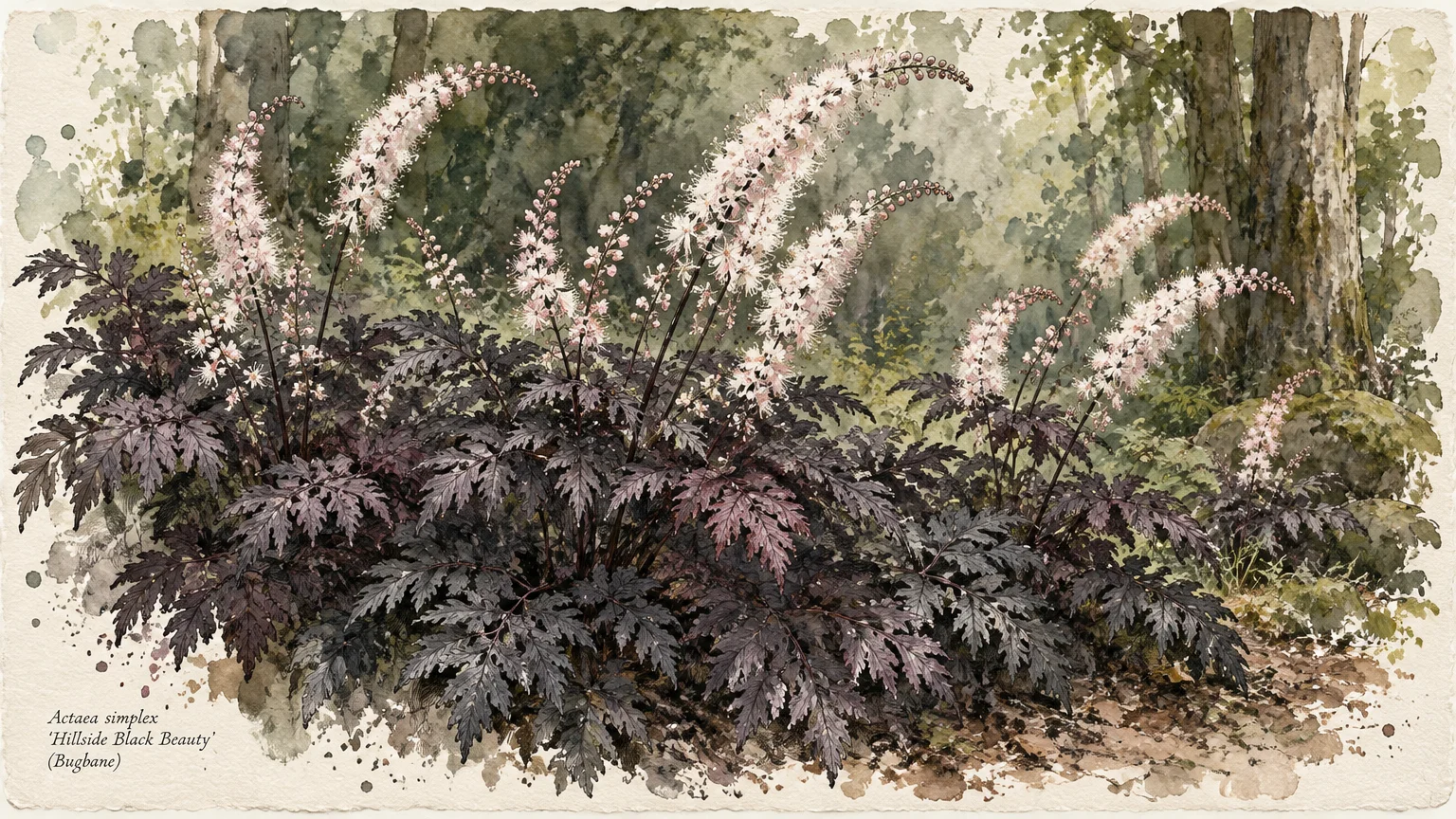
Outdoor Strategy #9: Hillside Black Beauty Bugbane (Actaea simplex ‘Hillside Black Beauty’)
Hillside Black Beauty bugbane injects dark elegance into shaded woodland beds where few black foliage plants can thrive. This perennial cultivar is hardy in USDA Zones 4 through 8, forming a three-foot foliage mound.
Its finely divided, lacy leaves emerge dark bronze and deepen to purplish-charcoal as the growing season progresses. In late summer, upright flower spires soar six feet high above the brooding foliage.
These bottlebrush-like flowers open in pale blush-white and emit a sweet fragrance reminiscent of ripe grapes. The luminous white spires create an ethereal focal point in dimly lit garden corners.
Provide consistently moist, humus-rich soil sheltered from strong winds that can topple tall blooming spikes. While it tolerates partial shade, several hours of gentle morning sun enhances the leaf saturation.
Incorporate generous amounts of leaf mold or compost at planting time to mimic natural woodland soil. Mulch annually to keep the shallow root system cool and evenly hydrated throughout summer.
Outdoor Strategy #10: Sweet Caroline Jet Black Sweet Potato Vine (Ipomoea batatas)
Sweet Caroline Jet Black sweet potato vine serves as a reliable trailing annual that blankets bare soil quickly. It thrives across all growing zones during summer heat and acts as a perennial in Zones 9 through 11.
The lobed, maple-like leaves exhibit a dense, non-fading purple-black finish from spring until the first autumn freeze. Its vigorous mounding and trailing habit spreads two to three feet wide in a single season.
Plant it in hanging baskets, window boxes, or border edges where the dark vines spill gracefully over walls. It pairs with silver licorice plant, bright petunias, and vibrant orange lantana.
Provide full sun for deep inky color, though the vine tolerates partial shade with only slight greening. Keep the soil moderately moist, and fertilize monthly with a balanced liquid feed to sustain rapid leaf growth.
Trim stray runners anytime during the season to maintain neat proportions and stimulate bushier growth. This fast-growing companion easily fills empty spaces while grounding your broader planting palette.
Seasonal Considerations for Your Garden
Spring offers the ideal window to plant new dark foliage shrubs and divide established perennial root clumps. Amend your soil with organic compost now to fuel strong foliage pigmentation throughout the coming months.
Summer heat increases water evaporation because dark surfaces naturally absorb higher levels of solar radiation. Monitor soil moisture closely and apply three inches of shredded bark mulch to prevent heat stress and leaf scorch.
Autumn requires digging and storing tender tubers like dahlias and elephant ears before frost damages cell walls. Allow perennial foliage like bugbane and ninebark to die back naturally to nourish the root crown.
Winter demands protective measures for evergreen black foliage plants such as black mondo grass in northern zones. Apply an extra layer of pine straw over crowns to shield them from desiccating winter winds and freeze-thaw cycles.
Prune your deciduous dark-leaf shrubs in late winter before bud break occurs. Hard pruning stimulates rapid spring flushes of young foliage, which consistently showcases the deepest color saturation.
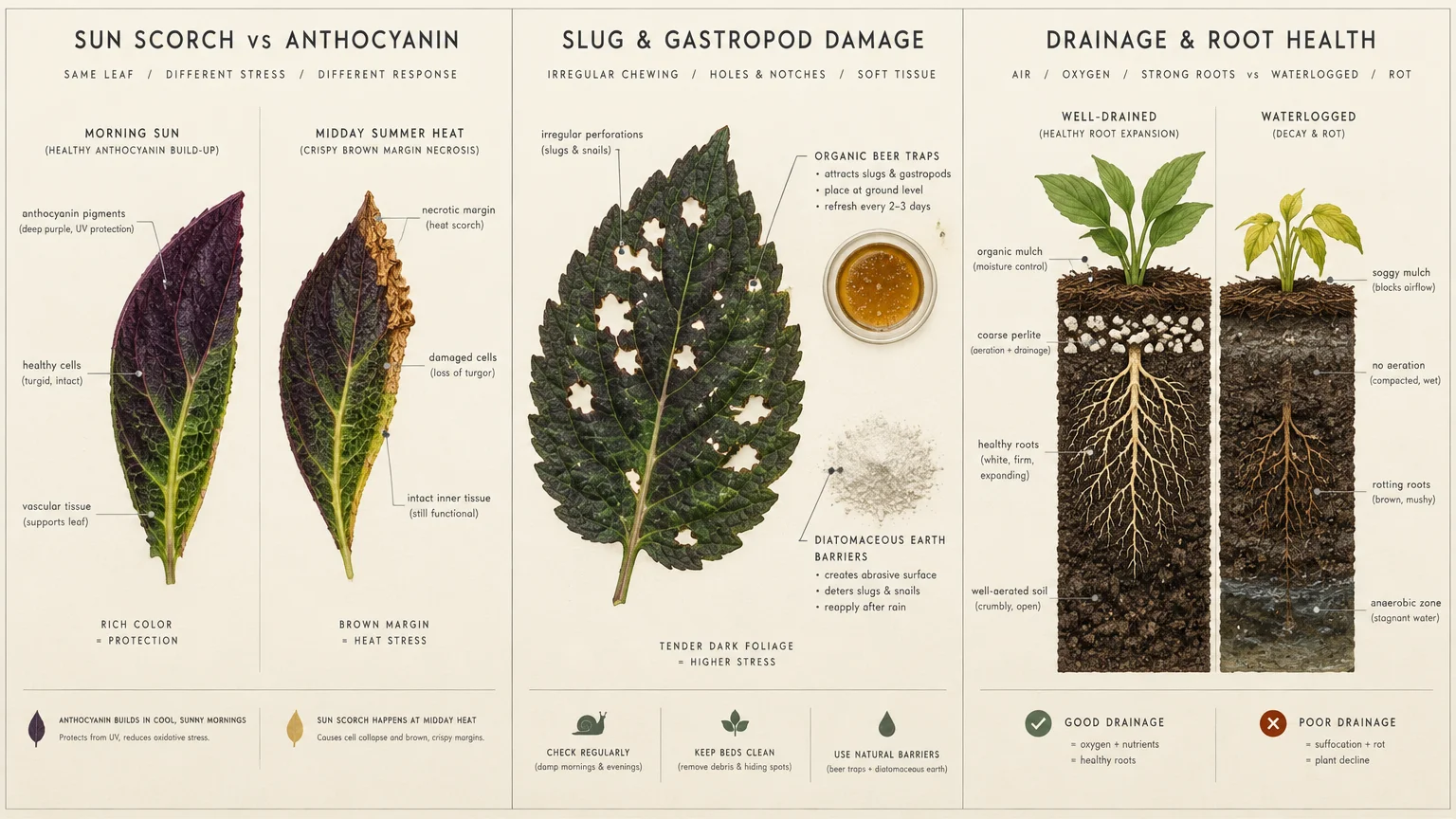
Dealing with Outdoor Pests and Weather
Managing solar exposure is critical because excessive ultraviolet radiation can bleach dark foliage or burn leaf margins. If leaves show brown, crispy edges, shift plants toward morning sun with filtered afternoon shade.
Slugs and snails target tender young shoots of dark leaved perennials like heuchera and dahlia tubers. Scatter organic iron phosphate bait around emerging crowns in early spring to prevent foliar damage.
Deer and rabbits frequently bypass tough dark foliage shrubs like ninebark and smokebush due to bitter compounds in the bark. Protect vulnerable young elephant ears and dahlias with physical netting until mature.
Fungal diseases like powdery mildew occasionally strike ninebark and elderberry during humid summer stretches. Space plants properly to ensure continuous airflow, and water directly at the root zone rather than overhead.
Prolonged drought causes dark leaves to turn dull bronze and shed prematurely. Install drip irrigation to deliver consistent, deep watering during extended heat spells without wetting the foliage.
Frequently Asked questions
Do dark leaf plants need full sun to stay black?
Most black foliage plants require at least six hours of direct sunlight daily to produce dark anthocyanin pigments. In heavy shade, their leaves will revert to dull green or bronze tones.
Which colors pair best with black foliage in a gothic garden?
High-contrast pairings work best; combine dark leaves with chartreuse, silver, or snow-white flowers. Vibrant saturated colors like fiery orange, magenta, and lemon yellow also create striking visual impact.
Are black leaf plants more susceptible to sunburn than green plants?
Yes, because dark pigments absorb more thermal energy than light green surfaces. Providing adequate soil moisture helps plants transpire effectively, cooling the foliage and preventing heat damage.
How can I use black foliage plants in small yards?
Use compact cultivars like Obsidian coral bells or black mondo grass as ground-level anchors in containers and tight borders. Dark foliage creates visual depth, making small garden spaces appear larger than they are.
Check your USDA Plant Hardiness Zone at the USDA’s website. For lawn and garden care advice, consult your local University Extension program (listed here).
Find native plant information from the National Wildlife Federation.
Disclaimer: This article provides general outdoor gardening advice. Success can vary greatly based on your specific climate, soil type, and local conditions.
Always choose plants appropriate for your USDA Hardiness Zone.